
October 10, 2026 · 2 min read
Outsmarting AI, Part 4: Simple Questions AI Gets Wrong
Part four: some questions are hard because they are complicated. Others are hard because they look complicated and aren't.
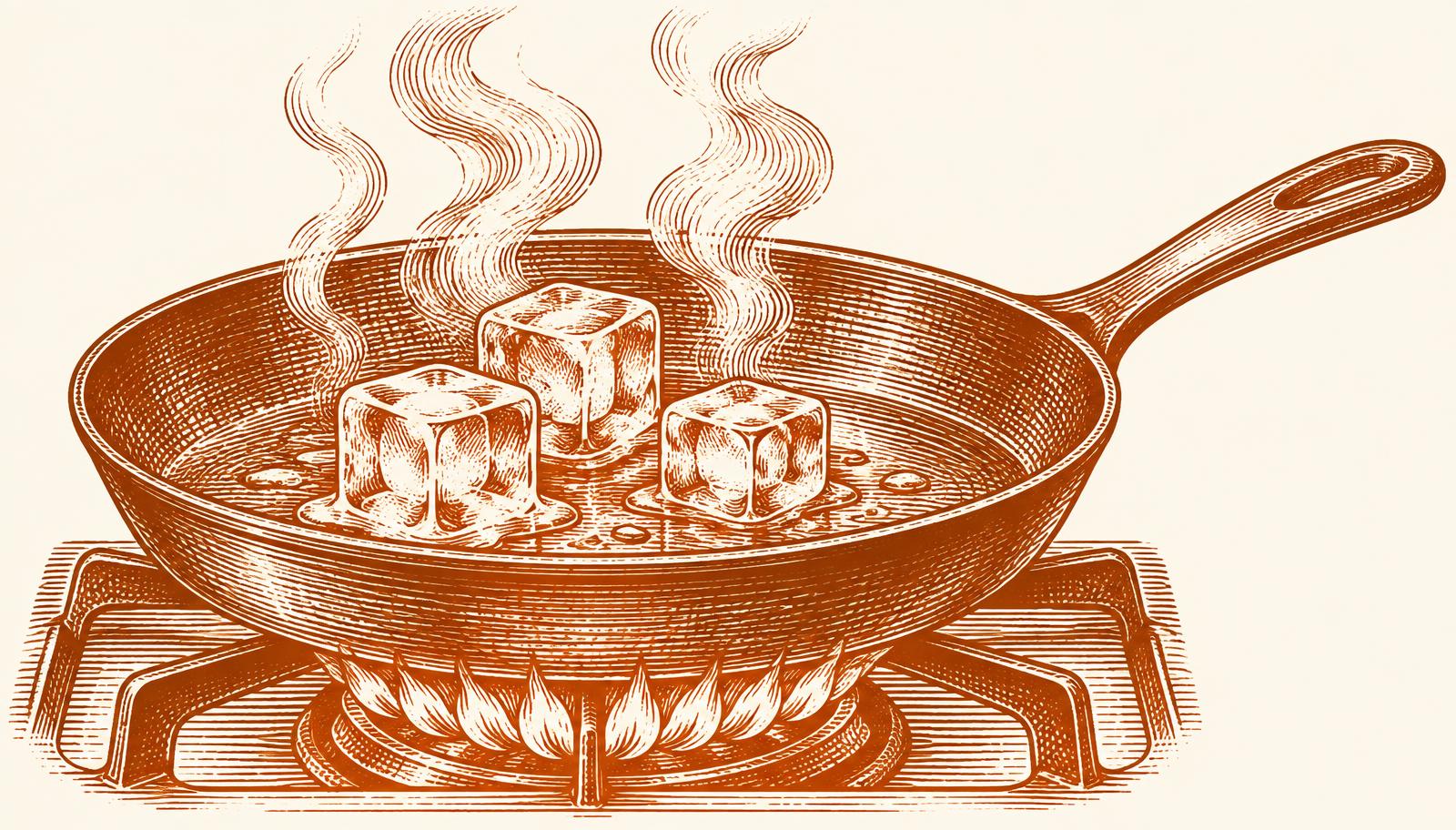
Here is a question that has embarrassed some very expensive software.
A cook drops three whole ice cubes into a hot frying pan at the start of the first minute, four more at the start of the second, and five more at the start of the third. She adds none in the fourth minute. How many whole ice cubes are in the pan at the end of the fourth minute?
The answer is none. The pan is hot. Every number in that paragraph is scenery.
You can try our version, with the full explanation, at Hot Pan Count.
The arithmetic decoy
Benchmarks like SimpleBench are built out of questions in exactly this shape: they resemble a harder problem the model has seen many times, so it recognizes the pattern and starts computing. Averages get taken. Sums get carried. The physical situation — ice, heat, melting — never enters the reasoning at all.
A second example from the same family: a juggler throws a blue ball one meter up and a purple ball two meters up, then climbs a ladder balancing a balloon on her head. Where is the purple ball now, relative to the blue one? On the floor, next to it, at the same height — because balls come down. The ladder is there to make you think about altitude.
Why this is a fair test
It would be easy to dismiss these as gotchas. They aren't, quite. Every one of them can be answered correctly by a ten-year-old who pictures the scene instead of parsing the sentence, and that is the point: the model has enormous knowledge and no mental image.
Human reasoning is stubbornly physical. You know ice melts not because you retrieved a fact but because you have held a cube until your hand hurt. That embodied shortcut is what the machine lacks, and no amount of text seems to supply it.
How to not fall for it yourself
Three habits catch nearly all of these:
- Picture it before you calculate. If the scene is absurd, the arithmetic is a decoy.
- Re-read the actual question. Not the setup — the sentence with the question mark. Often it asks for something different from what the setup trained you to compute.
- Be suspicious of tidy numbers. A problem engineered to produce a clean average is usually engineered for a reason.
Our Today's Problem tee works the same nerve — a single sentence about days of the week that nearly everyone answers too quickly.


Get the Today's Problem shirt →
SimpleBench and the examples discussed here appear in "Can you outsmart AI?" by Grace Huckins, MIT Technology Review. The puzzle above is our own.
Get new puzzles?
Get new puzzles and Puzzle Journal posts by email, plus 10% off your first shirt.
No spam. Unsubscribe anytime.