
October 12, 2026 · 9 min read
Sudoku: How Puzzles Are Made—and What Makes Them Hard
The rules fit in a sentence. The craft behind the grid is another story. Explore Sudoku’s origins, the logic behind difficulty ratings, and our new Sudoku Across the Finish Line tee.
A Sudoku grid can look almost empty and turn out to be surprisingly friendly. Another can be crowded with numbers and still stop you cold. That is the first interesting thing about Sudoku difficulty: the number of blanks is not the whole story.
The real question is what you have to notice—and how many logical connections you must make—to fill them. With our Sudoku Across the Finish Line tee now available, it seems like a good time to look beyond the grid: where Sudoku came from, how puzzles are created, and what separates a relaxing solve from a serious challenge.
Simple rules. No arithmetic required.
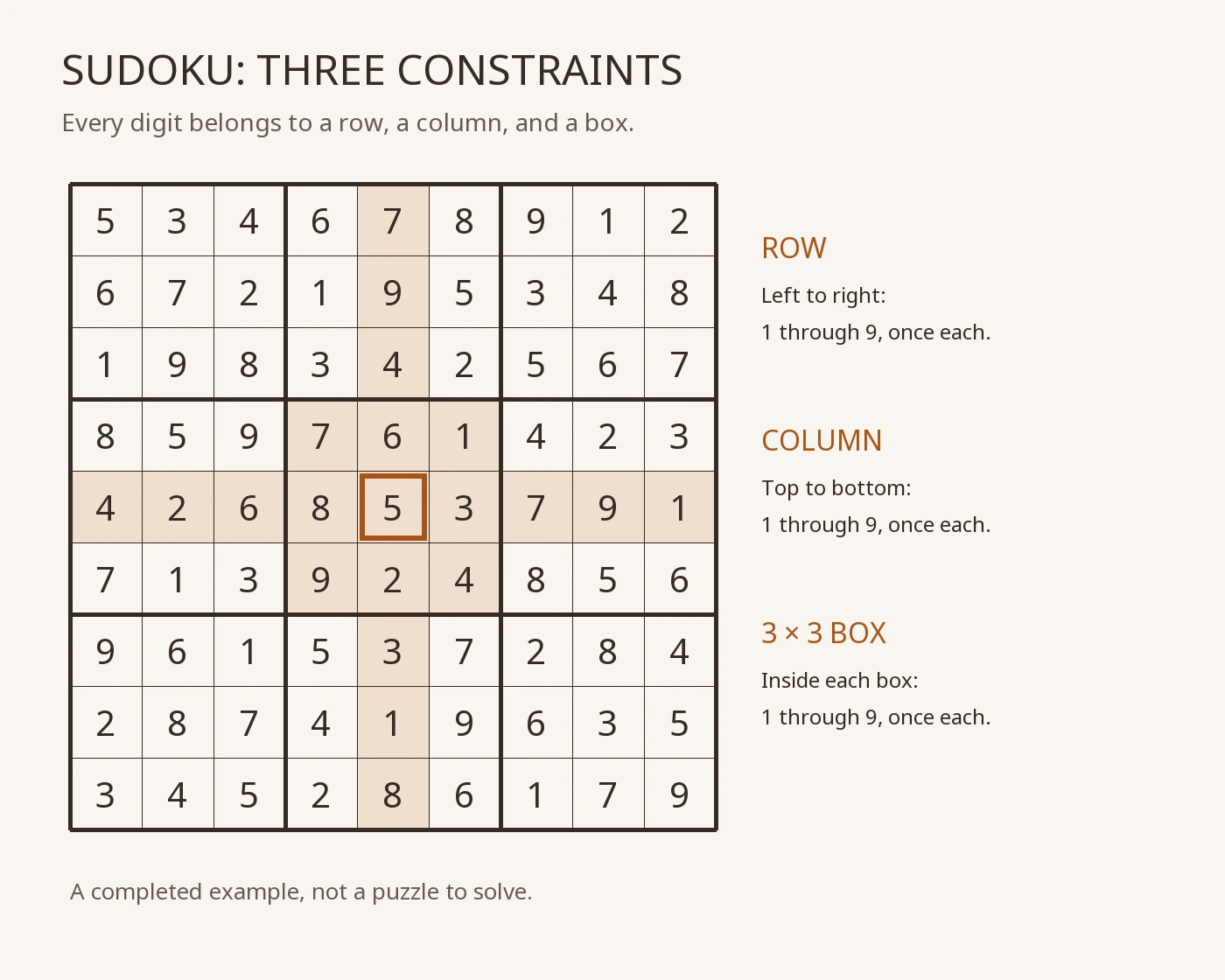
Standard Sudoku uses a 9 × 9 grid divided into nine 3 × 3 boxes. Fill the empty cells so that every row, every column, and every box contains the digits 1 through 9 exactly once. The printed numbers are the starting clues, often called givens.
You never need to add, multiply, or calculate a total. The digits are labels. You could replace them with nine distinct symbols and preserve the underlying puzzle. Sudoku is a problem of placement and exclusion: if a 6 is already in a row, no other cell in that row can contain 6.
An American puzzle with a Japanese name
The modern puzzle first appeared as Number Place in a Dell puzzle magazine in 1979 and is credited to American architect and puzzle constructor Howard Garns. Japanese puzzle publisher Nikoli introduced it in 1984 and popularized the name Sudoku, shortened from a phrase meaning that the numbers must be single.
The next major wave came through newspapers. Wayne Gould, a retired judge from New Zealand, developed Sudoku software and helped bring the puzzle to The Times in London in 2004. It spread far beyond the newspaper page into books, apps, competitions, and the familiar daily ritual of a pencil and a grid.
That history is a useful reminder: a puzzle does not need complicated instructions to have depth. Sudoku’s rules stay the same whether you are solving your first grid or studying an expert-level one.
What actually makes a Sudoku easy or hard?
Difficulty comes largely from the reasoning needed to make progress, not simply from how many numbers are missing. The arrangement of the clues matters. So does how clearly one deduction opens the way to the next.
Easy: the next number is close at hand
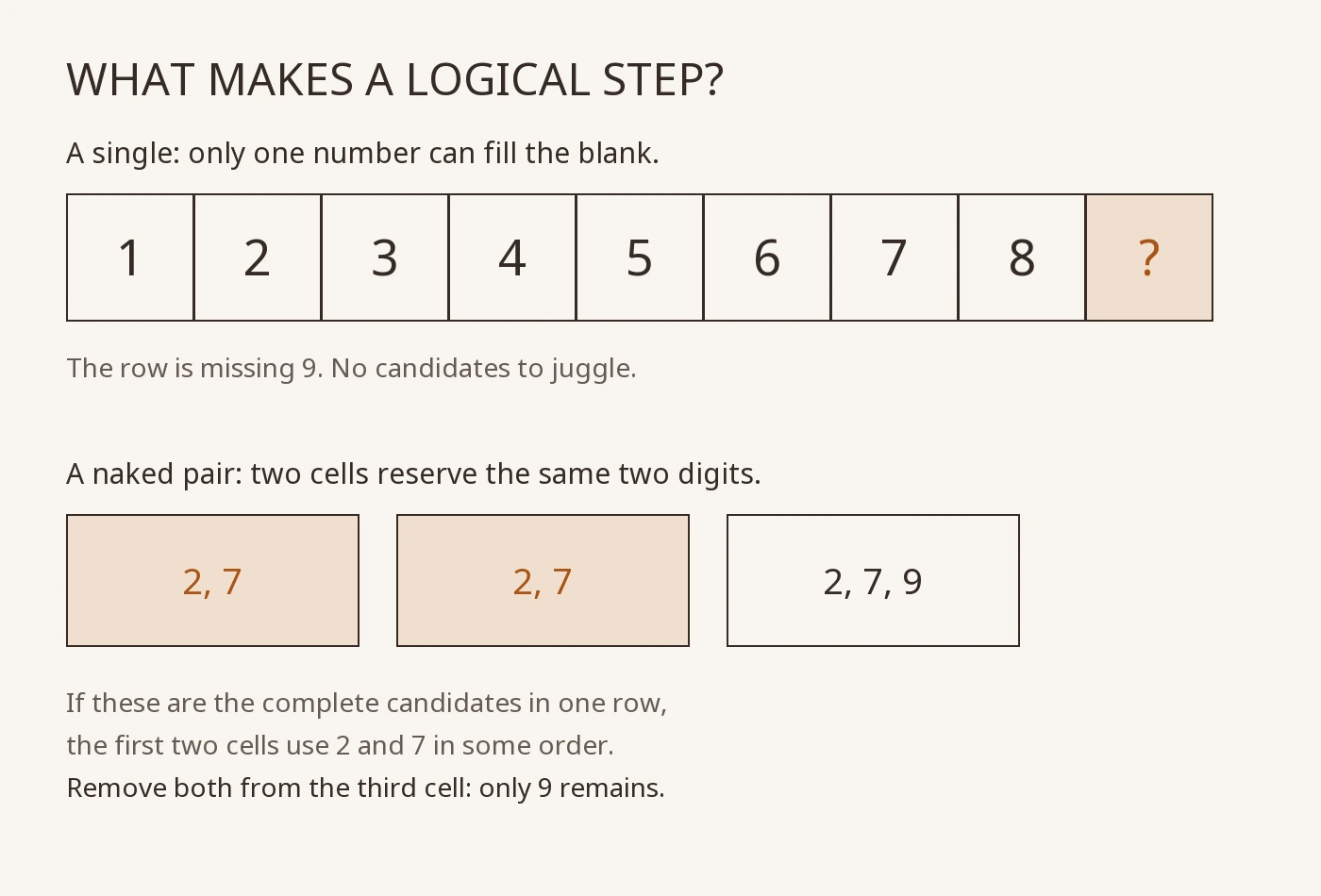
Beginner-friendly puzzles often yield to scanning and singles. A naked single is a cell with only one possible candidate after its row, column, and box are checked. A hidden single is a digit that has only one possible location within a row, column, or box—even if that cell still appears to allow several digits when considered by itself.
Both are forced placements, but they ask you to look in different ways: “What can go in this cell?” versus “Where can this digit go in this unit?” A well-paced easy puzzle keeps rewarding those questions.
Medium: the candidates start working together
As puzzles become more demanding, it helps to write small pencil marks for the digits each empty cell could still contain. You may need to spot pairs: two cells in the same row, column, or box that can contain only the same two digits. Those digits are reserved for those two cells, so you can eliminate them elsewhere in that unit.
Another common step is a locked candidate. If all possible positions for one digit inside a box lie on the same row, that digit cannot appear elsewhere on that row outside the box. Nothing has been guessed; you have used an overlap between two constraints.
Hard and expert: relationships span the grid
More demanding puzzles can require patterns across multiple rows and columns. An X-Wing, for example, can arise when a digit has exactly two candidate positions in each of two rows, aligned in the same two columns. Those four corners constrain where the digit can appear and allow eliminations in the rest of those columns. The same idea can be turned sideways.
Beyond that are larger patterns and chains of implications. The challenge is not advanced arithmetic. It is recognizing a relationship that is less local, tracking it accurately, and finding the useful elimination among many possibilities.
These are illustrative stages, not a universal grading chart. One publisher’s “hard” can be another’s “expert.” A technique you know well may feel easy, while a less familiar pattern creates a bottleneck.
How do constructors make a Sudoku?
There is no single method. Some constructors work by hand, some use software, and some combine the two. A common computer-assisted approach works backward from a completed grid.
- Start with a valid solution. Every row, column, and box must already obey the rules. A randomly filled square is not enough.
- Remove selected numbers. This creates the starting clues. A constructor might remove clues in symmetric pairs to make the pattern visually balanced, but symmetry is a design choice—not a Sudoku rule.
- Check that the solution is unique. After removing clues, a solver checks whether there is exactly one way to finish. If a removal allows multiple solutions, the constructor can restore that clue or try a different arrangement.
- Test the intended solving path. A program that finds a solution by trial and error proves something different from a solver that follows human-style deductions. To target a difficulty level, the constructor needs to examine which techniques make progress.
- Revise and playtest. Add, remove, or reposition clues, then check uniqueness and difficulty again. A human tester can reveal awkward pacing or a deduction that is much harder to spot than the software’s score suggests.
The crucial distinction is between validity and experience. A grid can have exactly one answer and still be poorly suited to beginners. Uniqueness says the destination is unambiguous; it does not tell you how enjoyable the route will be.
How do you deliberately target a difficulty level?
Imagine that a constructor wants an easy puzzle. They might test whether the grid can be completed using scanning and singles alone. If those techniques stall, they can revise the clues until a straightforward path exists.
For a more challenging puzzle, the target might include pairs, locked candidates, or a particular advanced pattern. But merely putting an X-Wing-shaped arrangement into a grid does not guarantee that solvers will need it. An easier route might bypass it. The whole puzzle has to be tested, not just the intended highlight.
Rating systems differ. Some emphasize the hardest technique required along the solving path they find. Others also consider how often difficult steps occur, how many deductions are needed, or how much searching is involved. Different solvers can find different paths through the same puzzle.
A constructor is therefore designing both the clues and the rhythm: an opening you can enter, enough resistance to keep you interested, and deductions that lead somewhere. Nikoli is especially known for its hand-crafted approach and its emphasis on the relationship between maker and solver.
Removing more numbers makes a grid emptier. It does not automatically make it a better—or harder—puzzle.
Why 17 clues is famous—and what it does not mean
For standard 9 × 9 Sudoku, 17 is the minimum number of starting clues that can give a unique solution. A computer-assisted exhaustive proof by Gary McGuire, Bastian Tugemann, and Gilles Civario, announced in 2012, established that no uniquely solvable 16-clue puzzle exists.
That does not mean any selection of 17 clues works. Most arbitrary removals will not produce a unique puzzle. Nor does it mean a 17-clue puzzle must be the hardest.
There is also a useful distinction between minimum and minimal. Minimum refers to the smallest possible clue count across all standard uniquely solvable puzzles. A particular puzzle is minimal if removing any one of its remaining clues destroys uniqueness. A minimal puzzle can have more than 17 clues.
Neither label tells you how difficult the puzzle will feel. The structure of the deductions still matters.
Sudoku Across the Finish Line
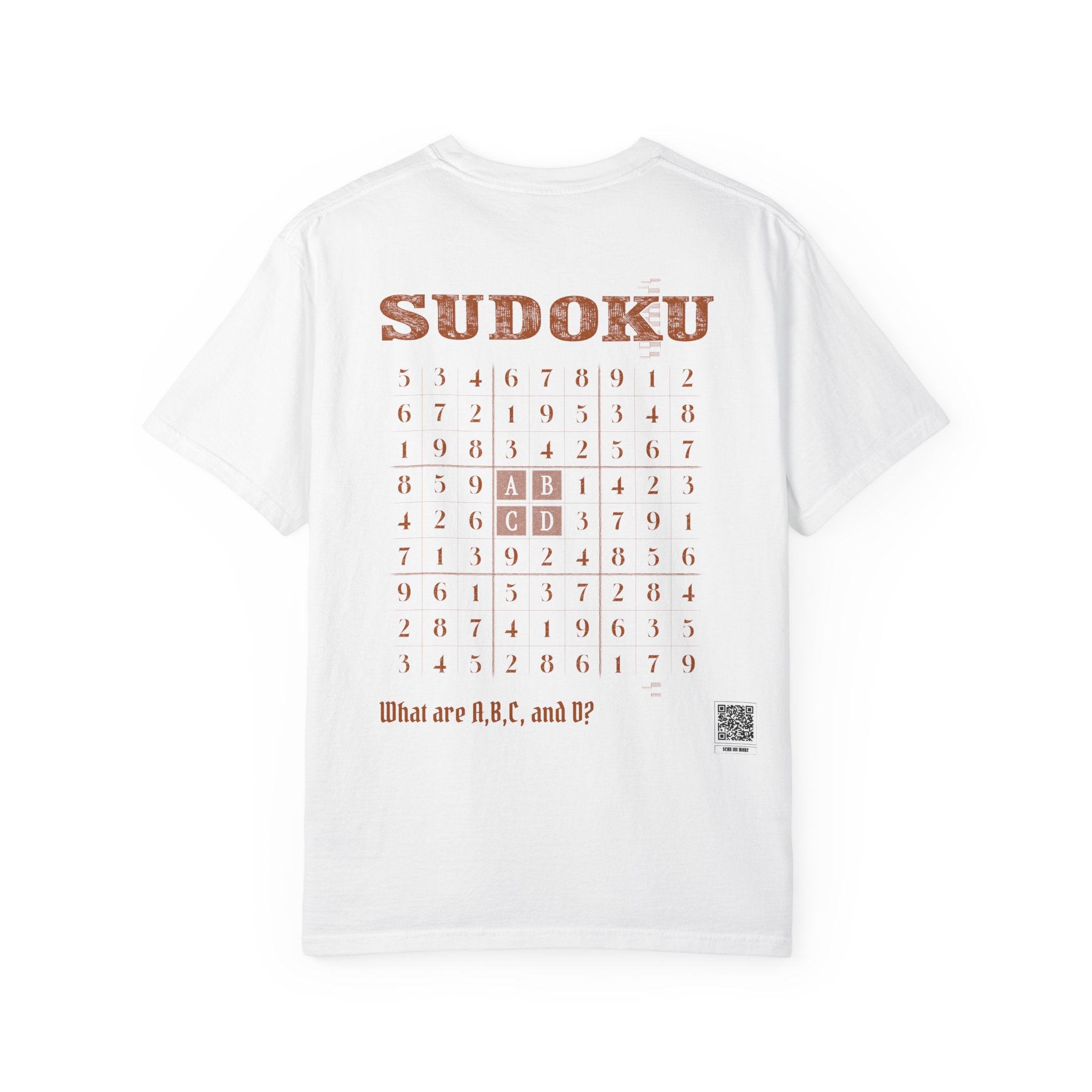
Our shirt takes a different approach from a full newspaper Sudoku: the hard part is already complete. Only four cells remain, labeled A, B, C, and D in a 2 × 2 block. Your job is to finish the grid.
The word SUDOKU crosses a lightly engraved checkered finish line, and the grid carries the idea down the design. The missing letters stand out against distressed blocks, so there is an obvious place for another person to start looking.
This is intentionally a short, approachable challenge, not an attempt to make someone solve an entire Sudoku on your back. A satisfying deduction can be enough to start a conversation. Difficulty is one kind of appeal; recognition, curiosity, and the pleasure of finishing something are others.
We will leave the four answers out of this article. Try Sudoku Across the Finish Line for the question, hint, and solution, or see the shirt.
A good puzzle meets you where you are
If you are new to Sudoku, start by asking what is missing from the most complete rows, columns, and boxes. If you already solve comfortably, try learning one unfamiliar technique and recognizing it without a hint. And if you just want a small puzzle that gives someone a reason to say hello, four missing cells can be exactly enough.
The beauty of Sudoku is not that every grid is brutally hard. It is that the same few rules can create so many different moments of discovery.
Sources and further reading
- Nikoli: Sudoku rules and history.
- Nikoli: Why hand-made puzzles?
- Wolfram MathWorld: Sudoku—background and mathematical context.
- McGuire, Tugemann, and Civario: There Is No 16-Clue Sudoku—the research establishing the minimum clue count.
- SudokuWiki: Sudoku Creation and Grading—construction and rating considerations.
Get new puzzles?
Get new puzzles and Puzzle Journal posts by email, plus 10% off your first shirt.
No spam. Unsubscribe anytime.