
History · Geometry · Discovery
All About Stomachion
Fourteen pieces. One square. A puzzle with ancient roots, a lost manuscript, and hundreds of ways to be right.
Solve Stomachion- 14
- Geometric pieces
- 536
- Distinct square solutions
- 2003
- Modern enumeration
A square that refuses to stay simple
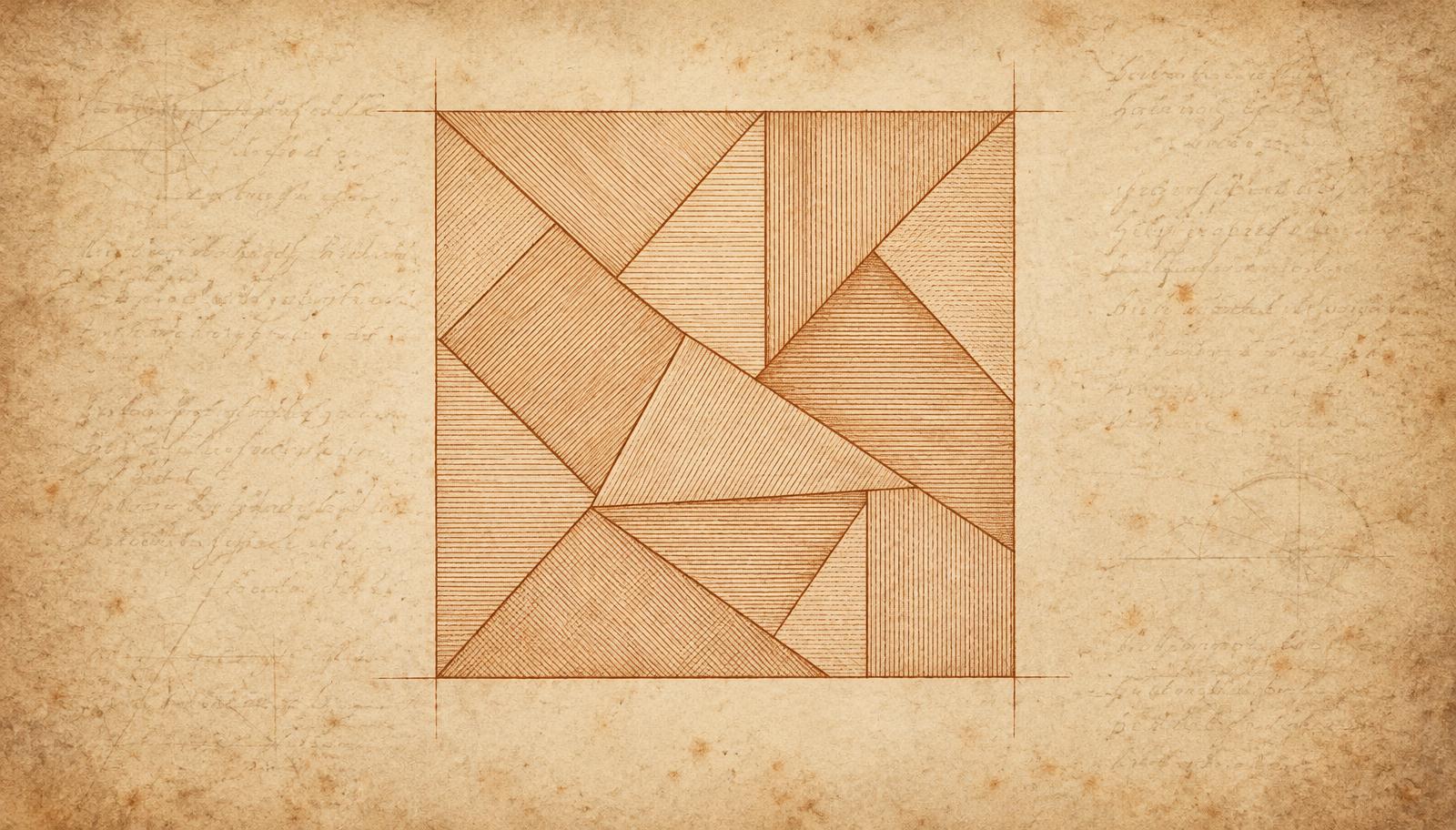
Stomachion—also known as Ostomachion—is a dissection puzzle: a shape is cut into pieces, and those pieces become the raw material for new arrangements. In its best-known form, a square is divided into fourteen polygons. Take them apart, then try to make the square again without gaps or overlaps.
That sounds modest. There is no hidden word, no calculation to perform, and no trick in the question. Yet the pieces have an awkward variety of angles and proportions. Several almost fit where they do not belong. A promising corner can leave an impossible sliver somewhere else.
The intriguing part is that there is not just one right answer. The familiar starting diagram is a solution, not the solution. Turn a piece, flip another, change how a cluster meets its neighbors, and the same fourteen shapes can make a genuinely different square.
Stomachion belongs to the same broad family of rearrangement puzzles as the seven-piece tangram, but it has its own dissection and its own history. It is not simply a tangram with extra pieces.
Archimedes, but not quite the story you expect
Archimedes lived in the third century BCE in Syracuse, on the island of Sicily. His surviving works range across geometry and mechanics. A mathematical work on the Stomachion is transmitted under his name, connecting this small puzzle to one of antiquity’s most remarkable thinkers.
That connection is real, but it needs a qualification: the surviving fragments do not prove that Archimedes invented the puzzle. They also do not give us a complete account of what he intended to establish. “A puzzle associated with Archimedes” is more careful than “a puzzle definitely invented by Archimedes.”
Late-antique Roman writers, including Ausonius, describe a fourteen-piece puzzle tradition associated with Archimedes. Latin sources refer to an “Archimedes’ box,” or loculus Archimedius. The pieces could be rearranged into recognizable figures, connecting mathematical shapes with imaginative construction.
The name is another small mystery. Historical forms include Stomachion, Ostomachion, and Syntemachion. Its precise meaning is uncertain, so colorful explanations of the name should not be mistaken for settled history.
A puzzle hidden beneath a prayer book
Part of the Stomachion text survives in the Archimedes Palimpsest. A palimpsest is a manuscript whose writing has been erased so its pages can be used again. Parchment was valuable; reusing it saved material, even when the older text was extraordinary.
A copy of Archimedes’ works was made in the second half of the tenth century. In the thirteenth century, the parchment was reused for a Greek prayer book, completed in 1229. The older mathematical writing remained beneath the newer text, faint and difficult to read.
- 1906 — Recognition
The scholar Johan Ludvig Heiberg identified Archimedean writing beneath the prayer-book text and studied what he could recover.
- 1998–1999 — A new chapter
The manuscript was sold at auction in 1998 and deposited at the Walters Art Museum in 1999 for conservation, imaging, and study.
- Modern imaging — More of the old writing emerges
Conservation and imaging techniques helped researchers distinguish the erased mathematical text from the writing above it, improving access to material that ordinary inspection could not reveal.
A separate Arabic textual witness also preserves Stomachion material, including geometric construction and discussion of the pieces’ areas. The Greek and Arabic evidence complement one another, but neither turns the surviving work into a complete ancient instruction manual.
There is a pleasing parallel here: scholars reconstructed a damaged text about a puzzle of reconstruction. Both tasks depend on fitting incomplete evidence together without forcing pieces into places they do not belong.
The mathematics inside the square
The classical dissection has eleven triangles, two quadrilaterals, and one pentagon. Its pieces are not equal in area. A tiny triangle and a large four-sided piece must cooperate to cover the same square.
On a 12 × 12 square, the areas run from 3 to 24 square units. Divide every piece’s area by 3 and the proportions become whole numbers: 1, 1, 2, 2, 2, 2, 3, 4, 4, 4, 4, 4, 7, and 8. Together they add to 48. Each piece therefore occupies an integer multiple of one forty-eighth of the square.
For a concrete example, a piece of area 12 occupies 12 out of 144 square units—one twelfth of the square. The largest piece, area 24, covers one sixth. Change the physical size of the puzzle and those proportions stay the same.
Area is useful, but it is not enough. Pieces with the right combined area can still have incompatible edges or angles. A gap of area 12 does not automatically accept a piece of area 12. Its outline matters too.
That tension is the heart of the puzzle: the amount of space and the shape of the space are different constraints. A successful square satisfies both at once.
One square, 536 distinct solutions
In 2003, Bill Cutler used computer enumeration to investigate the square assemblies. The famous result is 536 distinct solutions. But “distinct” does important work in that sentence.
Imagine finishing the square and then turning the entire board a quarter-turn. You have changed its orientation, not discovered a new internal arrangement. Similarly, a mirror image of the whole square is treated as the same solution in the 536 count. Two pairs of pieces are geometrically identical; exchanging the copies within either pair does not create a new shape arrangement.
Original
Rotated
Reflected
If every piece is labeled and the board’s orientation is distinguished, the enumeration contains 17,152 arrangements. Ignore swaps of identical copies and there are 4,288. Also identify the square’s rotations and reflections, and the total becomes 536.
For this enumeration, the relationship is 536 × 8 × 2 × 2 = 17,152: eight whole-square symmetries and two ways to label each of the two identical pairs. These are different ways of counting the same family, not contradictory answers.
Crucially, 536 counts arrangements that form the original square. It does not count every animal, person, or other silhouette the pieces could make. Flipping pieces is allowed in the square puzzle described here.
Computers answer the exhaustive counting question, but they do not remove the human challenge. Knowing that hundreds of answers exist is very different from finding one with fourteen loose pieces in front of you.
A square is only the beginning
The same pieces can make outlines beyond the square. Ancient literary testimony describes figure-making, while modern demonstrations include animal-like silhouettes. This gives Stomachion two appealing sides: the precision of fitting a fixed boundary and the creativity of inventing a new one.
Keep the historical distinction in mind. A modern elephant-like arrangement shows what the pieces can do; it is not proof that the same elephant was a target prescribed by Archimedes. The surviving treatise is too fragmentary for that claim.
A physical set makes the creative side especially inviting. Trace the classical diagram onto stiff paper, keep the proportions intact, and cut along its internal lines. With the pieces separated, you can explore how long edges combine, how triangles form larger shapes, and how a familiar silhouette emerges from abstract polygons.
PuzzleWhere’s online version concentrates on reassembling the square. It keeps the goal precise while leaving room for many different successful arrangements.
Finding your first square
A useful approach is to think about the space you are creating, not only the piece you are placing. A piece can fit perfectly now and still leave a gap that no remaining piece can fill.
- Study the boundary. A square needs straight sides and right-angle corners. Notice which edges and combinations of angles could contribute to them.
- Work in small clusters. Two or three pieces can form a simpler shape—a triangle, a rectangle, or a straight edge—that is easier to reason about than each piece alone.
- Watch narrow gaps. Before committing to a placement, compare the remaining opening with the actual outlines of the unused pieces.
- Remember the flip. Rotation and reflection are different operations. Turning a piece over can expose an edge relationship that rotating it never produces.
- Backtrack without regret. A failed arrangement tells you something. Undoing a plausible choice is part of solving, not a sign that you missed a trick.
Introduction 1
3 pieces to fit
Introduction 2
6 pieces to fit
Full challenge
All 14 pieces to fit
Our first guided introduction leaves only a few pieces to fit. Solve it to unlock the second, with more open spaces and a need for rotation and flipping. The full challenge starts with all fourteen pieces to place.
“Can it be finished?” checks whether the pieces already on the board agree with any square in the numbered solution library. Hints and reveals use compatible arrangements, so they work with what you have already placed rather than insisting on one fixed answer.
A completed square is accepted by its geometry: all fourteen pieces must be inside the boundary, with no overlapping interiors. The numbered library identifies which solution you found; it is not a substitute for checking that your square is valid.
The puzzle is free to solve and needs no account. Attempts, times, and full-challenge solution numbers stay in your browser. Guided results are kept separate, and revealing an answer does not count as solving it.
For the story behind PuzzleWhere’s online version, read Stomachion, Fourteen Pieces and One Square.
Sources & further reading
Manuscript history, ancient testimony, and modern computation answer different questions. The sources below distinguish documented evidence from interpretation; the ancient work’s exact purpose remains debated.
- Archimedes Palimpsest Project — manuscript history
The manuscript’s copying, reuse, identification, and modern conservation.
- Netz, Acerbi & Wilson — Towards a Reconstruction of Archimedes’ Stomachion (2004)
A scholarly reconstruction of the Greek and Arabic fragments and a proposed combinatorial interpretation.
- NYU / Chris Rorres — The Stomachion
Ancient testimony, historical names, and the puzzle’s mathematical context.
- Wolfram MathWorld — Stomachion
The dissection, area relationships, and modern square-solution counts.
- Laurent Lessard — Ostomachion
A modern computational investigation of the arrangements and their symmetries.
- Ausonius, Loeb Classical Library — the Archimedean puzzle
Late-antique literary evidence for the fourteen-piece puzzle tradition.
- Morelli — Stomachion: archeologia di un gioco antico (2009)
Historical testimony and a contrasting discussion of the ancient work’s purpose.